HALLMARKS OF ENGLISH SILVER
MAKER'S MARK IDENTIFICATION - ILLUSTRATED LISTING
WITH THE ADDITION OF SCOTTISH, IRISH, CHANNEL ISLANDS AND COLONIES SILVERMITHS
|
This is a page of A Small Collection of Antique Silver and Objects of vertu, a 1500 pages richly illustrated website offering all you need to know about antique silver, sterling silver, silverplate, sheffield plate, electroplate silver, silverware, flatware, tea services and tea complements, marks and hallmarks, articles, books, auction catalogs, famous silversmiths (Tiffany, Gorham, Jensen, Elkington, WMF, Reed & Barton, Mappin & Webb, Bateman Family), history, oddities ...
SITE MAP -
HOME PAGE
|
BRITISH SILVERSMITHS
ILLUSTRATED LISTING OF SILVER MAKERS MARKS
O& - OZ |
| ALPHABETICAL LISTING OF MAKER'S MARKS |
| ALPHABETICAL LISTING OF SILVERSMITHS' NAMES |
(click on the photo to enlarge image)
 |
|
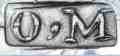 |
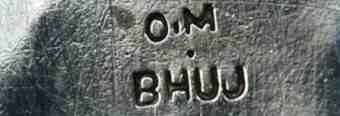
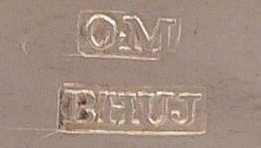
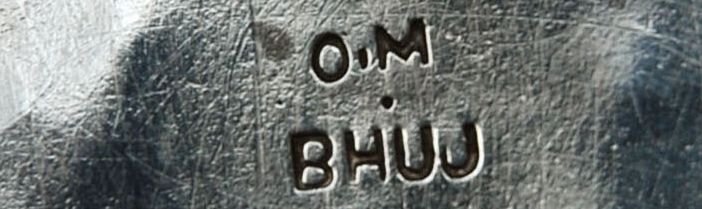
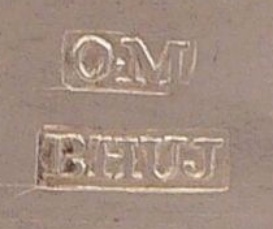
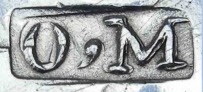
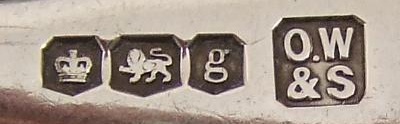
O.M
Oomersi Mawji,
Oomersi Mawji was
a very famous Indian silversmith who worked in BHUJ, which is in Kutch, Gujarat (India). He was born in Gujarat and was of Indian descent.
His mark is included in this directory as he was active during British domination of India and his works may be classified as "English Colonial
Silver". His work is not hallmarked (in the English way)
but has a high percentage of silver. His own work is marked OM and he started to be well known around 1860. He used a special process and a
brief description is given in V&A Museum website. He was known worldwide and will have sold through outlets in Calcutta and Bombay. His
work became very expensive and the designs had to be simplified and his sons continued this. Certainly his family’s work was sold through
Liberty of London and there is a page in a catalogue giving examples.
Bhuj, Gujarat (India, north of Mumbai) c. 1890 |
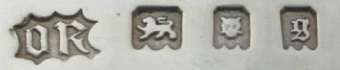 |
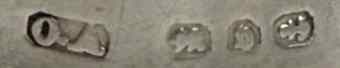
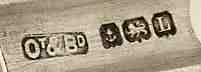
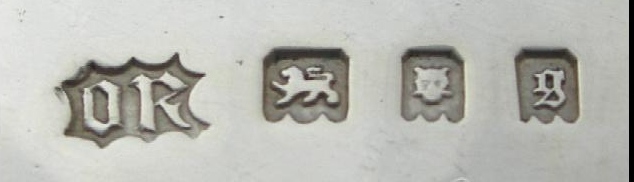
OR
Omar Ramsden,
London 1922 hallmark
(born Sheffield, 21 Aug 1873; died London, 9 Aug 1939). The son of a silver and electroplate manufacturer, he was apprenticed to a company of
silversmiths and attended evening classes at Sheffield School of Art and later at the Royal College of Art in London. In 1898 Ramsden set up a
partnership with Alwyn Carr in London to produce fine ‘art’ silver. They exploited the fashionable taste for handmade silver of the Arts and
Crafts Movement and, with the help of skilled artisans, made articles adapted from Gothic and Renaissance designs with Celtic-style
inscriptions, which became their trademark.
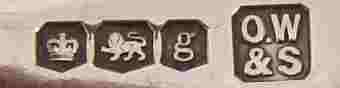
OMAR RAMSDEN: MARKS, HALLMARKS, HISTORY |
 |
|  |
|
|
BRITISH TOWN MARKS AND DATE LETTERS
|
MORE on the tutorial:
HOW TO READ ENGLISH/BRITISH STERLING SILVER MARKS
The hallmarking of British silver is based on a combination of marks that makes possible the
identification of the origin and the age of each silver piece manufactured or traded in the UK. The marks are:
Town mark, corresponding to the mark of the Assay Office that has verified the piece
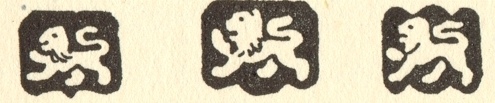
Lion passant guardant or Britannia or lion's head erased, certifiying the silver quality
Maker's mark, identifying the silversmith presenting the piece to the assay office (usually the initials of Christian name and surname of the silversmith)
Date letter, in cycles of twenty letters of the alphabet of different shape identifies the year in which the piece was verified by the Assay Office
A further mark was used in the period 1784 - 1890:
Sovereign head ('duty mark'), certifying the payment of the duty
This page was useful? leave your LIKE on
facebook
work in progress on this page - your help, corrections and suggestions will be greatly appreciated -
|




 London
 Birmingham
 Dublin
 Edinburgh
 Glasgow
 Sheffield
 Chester