HALLMARKS OF ENGLISH SILVER
|
| created by Giorgio B. owner of www.silvercollection.it ©  |
 |
 |
|
This is a page of A Small Collection of Antique Silver and Objects of vertu, a 1500 pages richly illustrated website offering all you need to know about antique silver, sterling silver, silverplate, sheffield plate, electroplate silver, silverware, flatware, tea services and tea complements, marks and hallmarks, articles, books, auction catalogs, famous silversmiths (Tiffany, Gorham, Jensen, Elkington, WMF, Reed & Barton, Mappin & Webb, Bateman Family), history, oddities ... SITE MAP - HOME PAGE |
| BRITISH SILVERSMITHS ILLUSTRATED LISTING OF MAKER'S AND SPONSOR'S MARKS AE |
(click on the photo to enlarge image)
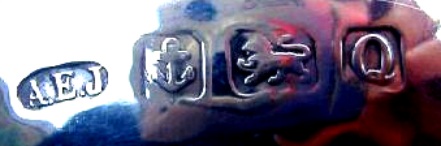
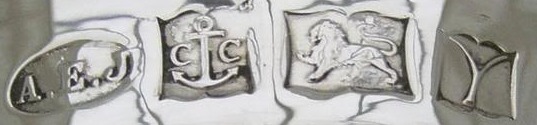
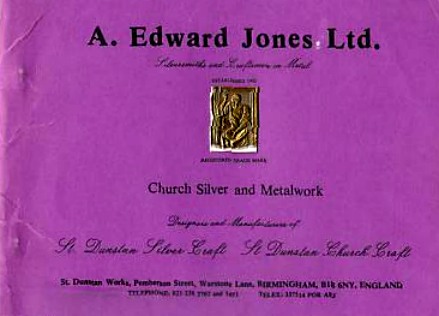
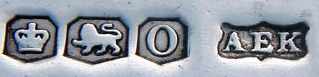
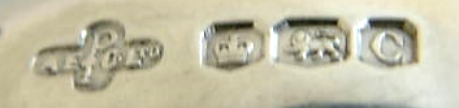
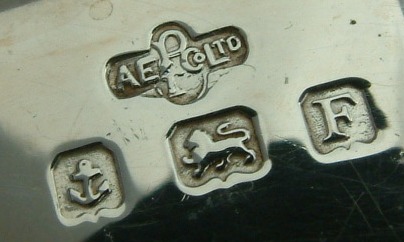
|
AEP&CoLtd |
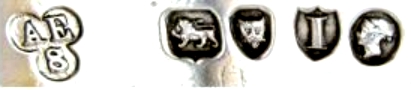 |
A E S into a trefoil |
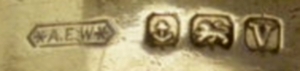 |
*A.E.W* into an oblong six sides polygon |
| STERLING SILVER OF ENGLAND, SCOTLAND, IRELAND, CHANNEL ISLANDS AND COLONIES |
| ALPHABETICAL LISTING OF BRITISH MAKER'S MARKS |
AA AE |
AF AZ |
BA BZ |
CA CH |
CK CZ |
DA DZ |
EA EZ |
FA FZ |
GA GZ |
HA HG |
HH HZ |
IA IG |
IH IZ |
JA JC |
JD JH |
JJ JP |
JQ JS |
| ALPHABETICAL LISTING OF BRITISH MAKER'S MARKS |
JT JZ |
KA LZ |
MA MZ |
NA PA |
PB PZ |
QA RH |
RK RZ |
SA SG |
SH SZ |
TA TH |
TI TZ |
UA WB |
WC WF |
WG WL |
WM WS |
WT ZZ |
| BRITISH SILVERSMITHS - ILLUSTRATED LISTING OF MAKER'S AND SPONSOR'S MARKS |
| A& | AA | AB | AC | AD | AE | AF | AG | AH | AI | AJ | AK | AL | AM | AN | AO | AP | AQ | AR | AS | AT | AU | AV | AW | AX | AY | AZ |
| B& | BA | BB | BC | BD | BE | BF | BG | BH | BI | BJ | BK | BL | BM | BN | BO | BP | BQ | BR | BS | BT | BU | BV | BW | BX | BY | BZ |
| C& | CA | CB | CC | CD | CE | CF | CG | CH | CI | CJ | CK | CL | CM | CN | CO | CP | CQ | CR | CS | CT | CU | CV | CW | CX | CY | CZ |
| D& | DA | DB | DC | DD | DE | DF | DG | DH | DI | DJ | DK | DL | DM | DN | DO | DP | DQ | DR | DS | DT | DU | DV | DW | DX | DY | DZ |
| E& | EA | EB | EC | ED | EE | EF | EG | EH | EI | EJ | EK | EL | EM | EN | EO | EP | EQ | ER | ES | ET | EU | EV | EW | EX | EY | EZ |
| F& | FA | FB | FC | FD | FE | FF | FG | FH | FI | FJ | FK | FL | FM | FN | FO | FP | FQ | FR | FS | FT | FU | FV | FW | FX | FY | FZ |
| G& | GA | GB | GC | GD | GE | GF | GG | GH | GI | GJ | GK | GL | GM | GN | GO | GP | GQ | GR | GS | GT | GU | GV | GW | GX | GY | GZ |
| H& | HA | HB | HC | HD | HE | HF | HG | HH | HI | HJ | HK | HL | HM | HN | HO | HP | HQ | HR | HS | HT | HU | HV | HW | HX | HY | HZ |
| I& | IA | IB | IC | ID | IE | IF | IG | IH | II | IJ | IK | IL | IM | IN | IO | IP | IQ | IR | IS | IT | IU | IV | IW | IX | IY | IZ |
| J& | JA | JB | JC | JD | JE | JF | JG | JH | JI | JJ | JK | JL | JM | JN | JO | JP | JQ | JR | JS | JT | JU | JV | JW | JX | JY | JZ |
| K& | KA | KB | KC | KD | KE | KF | KG | KH | KI | KJ | KK | KL | KM | KN | KO | KP | KQ | KR | KS | KT | KU | KV | KW | KX | KY | KZ |
| IMAGES | A& AC |
AD AK |
AL AZ |
B& BB |
BC BO |
BP BZ |
C& CA |
CB CC |
CD CF |
CG CL |
CM CS |
CT CZ |
D& DB |
DC DL |
DM DZ |
E& EA |
EB ED |
EE EH |
EI EO |
EP EZ |
F& FD |
FE FJ |
FK FZ |
G& GB |
GC GG |
GH GL |
GM GR |
GS GZ |
| IMAGES | H& H& |
HA HB |
HC HE |
HF HL |
HM HU |
HV HZ |
I& IG |
IH IL |
IM IZ |
J& JA |
JB JC |
JD JG |
JH JK |
JL JQ |
JR JR |
JS JS |
JT JZ |
KA KZ |
L& LB |
LC LZ |
M& MB |
MC MI |
MJ MZ |
N& NZ |
OA OZ |
P& PK |
PL PZ |
QA QZ |
| IMAGES | R& RB |
RC RG |
RH RK |
RL RQ |
RR RZ |
S& SB |
SC SI |
SJ SR |
SS SZ |
T& TC |
TD TG |
TH TN |
TO TS |
TT TZ |
UA UZ |
V& VZ |
W& WA |
WB WB |
WC WC |
WD WE |
WF WG |
WH WL |
WM WM |
WN WR |
WS WS |
WT XZ |
YA YZ |
ZA ZZ |
| LISTING OF NAMES | 18th CENTURY | 19th CENTURY | 20th CENTURY | PER TOWN |
| THE DIRECTORY OF SCOTLAND (PROVINCIAL) - CHANNEL ISLANDS - CANADA - AUSTRALIA - CAPE |
| THE DIRECTORY OF SCOTTISH PROVINCIAL SILVER |
THE DIRECTORY OF CHANNEL ISLANDS SILVER |
THE DIRECTORY OF CANADA SILVER |
THE DIRECTORY OF AUSTRALIA SILVER |
THE DIRECTORY OF CAPE COLONY SILVER |
|
BRITISH TOWN MARKS AND DATE LETTERS
|



| SILVER HALLMARKS DIRECTORY: Main Page - Australia - Austria - Canada - Cape Colony - Channel Islands - Continental (Silver plate) - England (town) - Famous makers - France - Germany - Hanau - Ireland - Italy - Mexico - Old Sheffield plate - Russia - Scotland - Scotland (Provincial) - UK (Silver plate) - UK makers (sterling) - USA (Silver plate) - USA (sterling) |
The hallmarking of British silver is based on a combination of marks that makes possible the
identification of the origin and the age of each silver piece manufactured or traded in the UK. The marks are:
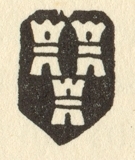
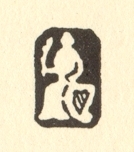
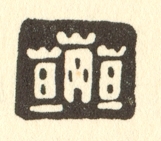
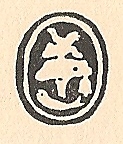
Town mark, corresponding to the mark of the Assay Office that has verified the piece
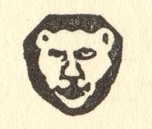
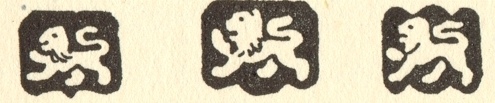
Lion passant guardant or Britannia or lion's head erased, certifiying the silver quality
Maker's mark, identifying the silversmith presenting the piece to the assay office (usually the initials of Christian name and surname of the silversmith)
Date letter, in cycles of twenty letters of the alphabet of different shape identifies the year in which the piece was verified by the Assay Office
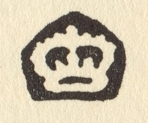
A further mark was used in the period 1784 - 1890: Sovereign head ('duty mark'), certifying the payment of the duty
Town mark, corresponding to the mark of the Assay Office that has verified the piece
 |
 |
 |
 |
 |
 |
 |
Lion passant guardant or Britannia or lion's head erased, certifiying the silver quality
 |
 |
 |
Maker's mark, identifying the silversmith presenting the piece to the assay office (usually the initials of Christian name and surname of the silversmith)
 |
Date letter, in cycles of twenty letters of the alphabet of different shape identifies the year in which the piece was verified by the Assay Office
 |
A further mark was used in the period 1784 - 1890: Sovereign head ('duty mark'), certifying the payment of the duty


 |

This page was useful? leave your LIKE on
facebook
work in progress on this page - your help, corrections and suggestions will be greatly appreciated -